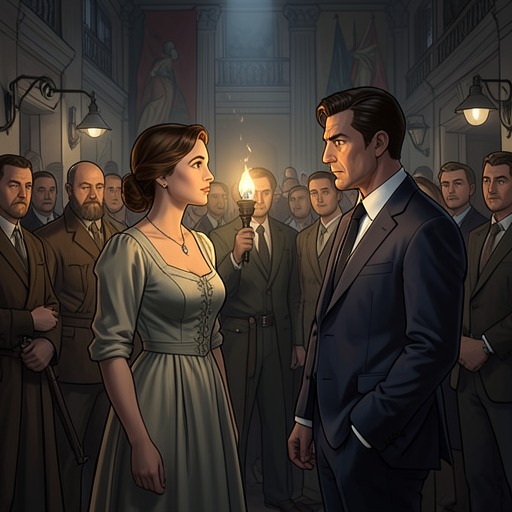
Rié and Makoto Hara’s marriage
A ManRié and Makoto Hara’s marriage was a real attachment lived under a false identity: Hara presented himself as Daisuké Taniguchi, and Rié built a family with the man she knew as her husband. His death did not simply end their relationship. It left Rié mourning him while unable to name him securely, and made the truth of his past inseparable from her own understanding of the life they had shared.
Identity and the Marriage
Rié knew her husband as Daisuké Taniguchi, but after his death she learned that this was not his real name. Daisuké’s brother came to see her and told her that the dead man was not his brother. The marriage’s defining contradiction thus emerged only afterward: the person Rié had loved and lived with had made a life in another man’s identity, while the history attached to that identity was not his own.
The distinction reaches into the couple’s family memories. Hara had told Yuto about growing up in Ikaho Onsen, quarrelling with his family, and coming to Rié after running away. When Rié eventually explained the deception to Yuto, she had to distinguish the man who had been his father from the past he had narrated: the story belonged to Daisuké Taniguchi, not to Hara. The disclosure did not make the family’s shared life unreal, but it unsettled the account through which that life had been understood.
Bereavement and the Unfinished Search
In the years after her husband died, Rié’s grief changed rather than simply disappearing. Its sharpness gradually crumbled into time, relieving her of the immediate crisis, yet a new loneliness sometimes settled into her body. When others suggested that she remarry, she shook her head with a smile and said she had had enough. Her response frames the marriage not as an episode she could readily replace, but as a bond whose loss continued to shape what she wanted from the future.
The unresolved name gave her mourning a practical question as well as an emotional one. Rié received word from Kido that he had made progress, though he still had not established X’s identity. She was apprehensive about what he might uncover, expecting an unsettling story, but desperately wanted to know who her husband had been. That knowledge, she felt, might clear not only the haze around his existence but also around her own past. Because she could not hurry Kido, particularly given the modest amount she had paid for the investigation, she had to wait for an answer on which her understanding of the marriage depended.
Telling Yuto the Truth
The secret entered the next generation through a confrontation over mourning. Yuto pointed out that another anniversary of his father’s death had passed without Rié making a grave for him. Rié recognized that he would not accept a vague explanation and, afraid of hurting him further, had delayed speaking openly about the death and its circumstances. At last she told him there was something she had kept from him: his father’s name had not really been Daisuké Taniguchi’s.
Yuto asked who his father had really been. Rié could not answer. She explained that she had gone to the police and hired a lawyer, but still did not know the man’s real identity; that uncertainty was why she could not make him a grave. The exchange connects the missing burial place to a missing name: Rié’s hesitation is not presented as indifference to her husband, but as the consequence of being unable to settle who the dead man was.
When Yuto asked whether his father had lied about his home and family, Rié stopped evading the question. Looking him in the eye, she told him that the story was Daisuké Taniguchi’s past, and then confirmed with two slight nods that his father had been lying. Her answer preserves a difficult distinction. Hara had deceived them about his history, but Yuto’s memories of his father and Rié’s love for her husband are not erased by the disclosure; instead, both must now be understood alongside the knowledge that the life Hara described was borrowed.
Kido’s Investigation and Hara’s Recovery
Kido’s investigation is also bound to his own response to the marriage. He had taken the case out of sympathy for Rié and wanted Hara to have been a decent man, despite whatever hardships had led him to lie. The possibility that Hara had escaped the burden of being Kenkichi Kobayashi’s son by placing that past on someone else disturbed Kido’s image of him. Yet Kido also recognized his own envy of a person who had apparently discarded a past and begun again. His hope that Hara had been worthy of Rié’s love sustained his interest in the case even as evidence complicated that hope.
As Kido wrote out Hara’s history, the investigation became more than the assembly of clues. He tried to preserve detail rather than reduce the man to a legal summary, likening his painstaking work to family members gathering ashes at a crematorium. Hara’s past, which had slipped toward oblivion while he was alive, could now be restored because the woman who had loved him was willing to open her heart and understanding to the whole of who he had been. Kido was unsure whether the person taking shape in his account should still be called Makoto Hara; nevertheless, bringing scattered fragments together eased his own anxiety and gave the dead man a more definite existence.
The account does not resolve the marriage by undoing its deception or recovering an uncomplicated version of the past. Instead, it shows Rié’s attachment enduring through bereavement, uncertainty, and belated truth-telling. Hara’s identity remains the object of a search, while the marriage itself is both the reason for that search and the relationship through which his recovered past can matter. Rié’s wish to know him fully makes remembrance an act of love, even when what it restores includes the lie at the center of their shared life.